Dog Body Language Chart & Cheat Sheet
Reading the quiet signals, before they get loud. 🐾
Dogs talk constantly, mostly without a sound. Here is the field guide. Read the whole dog, in context. One signal is a comma, not an alarm. It is clusters of signals, in the wrong moment, that tell the real story.
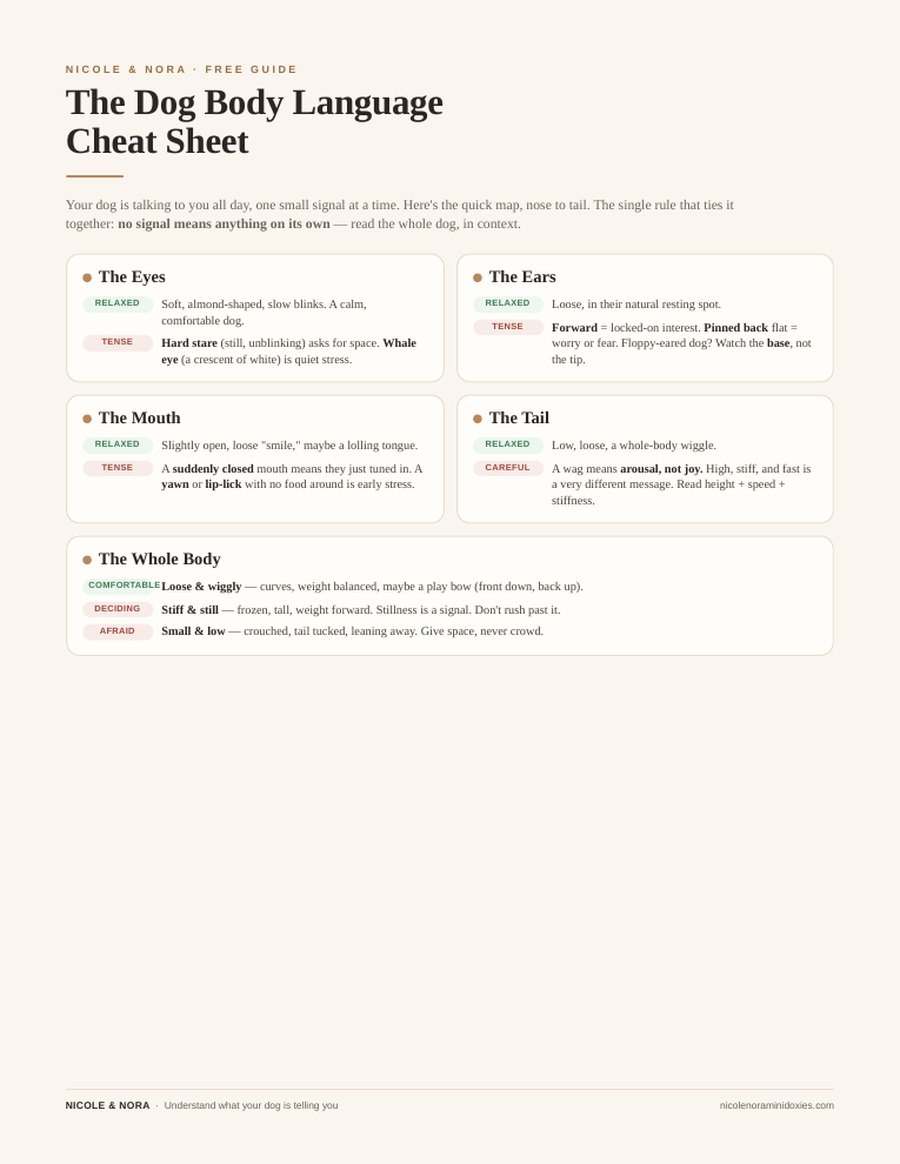
Get the free printable
Want this as a one-page printable to keep on the fridge? Pop in your email and download the PDF instantly.
👁️ Eyes
- Soft, almond eyes. Loose lids, blinking. A comfortable dog.
- Whale eye. A half-moon of white as they glance sideways, head still. "I need space."
- Hard stare. Fixed, unblinking. Tension. Do not lean in.
- Looking away. Deliberately breaking eye contact to defuse a moment.
👄 Mouth
- Loose, open, "smiling." Relaxed jaw, easy panting. All good.
- Lip or nose lick, no food around. A quiet "I'm not quite comfortable."
- Yawning when not tired. Self-soothing in a tense moment.
- Closed, tight mouth. The relaxed pant just stopped. Something shifted.
👂 Ears (learn your dog's neutral first)
- Neutral & natural. Resting in their normal position for the breed.
- Forward & stiff. Locked onto something. Alert, aroused.
- Pinned back & flat. Worry or appeasement. Making themselves small.
🦴 Tail (a wag = arousal, not "happy")
- Level, loose, whole-body wag. About as friendly as it gets.
- Low or tucked. Worry or fear. A small, unsure dog.
- High & stiff, fast flick. Arousal or warning. Not an invitation.
- Fun fact. Dogs wag more to the right for things they like, more to the left for things they don't.
🐕 Whole body
- Loose & wiggly. Curves, not lines. A comfortable dog is a soft dog.
- Stiff or frozen. Going still is not "being good." It can be holding their breath.
- Shake-off when dry. A little reset after a stressful moment.
- Turning or curving away. Politely asking to slow things down.
✅ Signs of a happy, easy dog
- Soft eyes, loose mouth, wiggly body. The whole picture is loose and round.
- A play bow. Front down, back up. "Let's play."
- Choosing to come closer. Freely closing the distance, on their own terms.
The stress ladder · catch it early
Dogs almost always ask quietly first. A dog punished for the quiet signals just stops giving them, and then you are left with only the loud ones. Answer the early ones and you rarely meet the late ones.
- 1 · Quiet asks. Yawn, lip lick, look away, sniff the ground, turn away, shake off.
- 2 · Getting louder. Freeze, whale eye, stiff body, pinned ears, closed mouth.
- 3 · Last resort. Low growl, lifted lip, snap. The polite requests went unheard.
Want to read all of this fluently? This is exactly what the Handbook trains, in five-minute lessons, until "I think something's off" becomes "I know what she's telling me."